The Jharkhand Teacher Eligibility Test (JTET) 2026 is a crucial exam for aspiring primary and upper primary teachers in Jharkhand. This detailed JTET syllabus 2026 breakdown covers both Paper 1 and Paper 2, helping candidates prepare effectively.
JTET syllabus 2026 Overview
JTET 2026 consists of two papers: Paper 1 for primary teachers (Classes 1-5) and Paper 2 for upper primary teachers (Classes 6-8). Each paper has 150 multiple-choice questions worth 150 marks, with a duration of 2.5 hours. There is no negative marking, and the exam assesses child development, pedagogy, languages, and subject-specific knowledge.
Both papers emphasize understanding child psychology, inclusive education, and teaching methodologies relevant to Jharkhand’s diverse student population. Qualifying JTET grants eligibility for teacher recruitment in government schools.
Paper 1 Syllabus: Primary Level (Classes 1-5)
Paper 1 targets foundational teaching skills for young learners. It includes five sections: Child Development & Pedagogy, Language I, Language II, Mathematics, and Environmental Studies, each carrying 30 marks.
Child Development and Pedagogy
This section evaluates candidates’ grasp of child growth stages, learning processes, and classroom strategies. Key topics include: for JTET syllabus 2026-
-
Child Development Concepts: Principles of development, heredity and environment influences, stages from infancy to childhood (physical, cognitive, social, emotional). Focus on Piaget’s stages of cognitive development, Vygotsky’s socio-cultural theory, and Kohlberg’s moral development.
-
Learning Theories and Processes: How children learn through play, observation, and interaction. Topics cover motivation, intelligence theories (Gardner’s multiple intelligences, Sternberg’s triarchic theory), and factors affecting learning like attention, memory, and reasoning.
-
Inclusive Education: Understanding diverse learners, including children with disabilities (visual, hearing, intellectual). Strategies for gender-sensitive teaching, addressing needs of disadvantaged groups, and creating barrier-free environments.
-
Pedagogical Issues: Classroom management techniques, continuous comprehensive evaluation (CCE), lesson planning, and use of teaching-learning materials (TLM) like charts and models. Emphasis on child-centered approaches over rote learning.
Candidates should prepare 30 questions testing application, such as handling slow learners or promoting critical thinking. This section forms the foundation for effective primary teaching.
Language I (Compulsory: Hindi/English or Urdu/English)
Language I assesses proficiency in the medium of instruction. For general candidates, it’s Hindi (15 questions) and English (15 questions); for Urdu teachers, Urdu and English. Topics include:
-
Language Comprehension: Reading unseen passages (prose/poetry), answering inference-based questions, summarizing main ideas, and identifying tone or purpose.
-
Grammar and Vocabulary: Parts of speech (nouns, pronouns, verbs), tenses, sentence structure, idioms, synonyms/antonyms, and spelling corrections. For Hindi: Sandhi, Samas, Karak, Alankar; for English: Articles, prepositions, active/passive voice.
-
Pedagogy of Language Development: Principles of language teaching, role of listening/speaking/reading/writing (LSRW), challenges in multilingual classrooms (common in Jharkhand), and remedial teaching for pronunciation issues.
This section tests both content mastery and teaching aptitude, with emphasis on developing communicative competence in young children.
Language II (Regional Language)
Candidates choose from regional languages like Hindi, Urdu, Santhali, Mundari, Ho, Kharia, Kurukh, Nagpuri, or Oriya. It mirrors Language I but focuses on pedagogy: for JTET syllabus 2026-
-
Comprehension and Grammar: Passage-based questions, grammar rules specific to the language (e.g., verb conjugations in Santhali), vocabulary building.
-
Teaching Methods: Oral language development, storytelling, drama, use of dictionaries, and addressing dialect variations in tribal areas of Jharkhand.
Preparation involves practicing language-specific texts and understanding NEP 2020’s multilingualism push.
Mathematics
Mathematics syllabus aligns with NCERT Class 1-5 standards, stressing conceptual clarity over computation:
-
Geometry: Shapes (2D/3D), patterns, symmetry, spatial understanding (maps, directions). Topics like drawing solids, understanding edges/vertices.
-
Numbers: Counting, place value, addition/subtraction/multiplication/division up to 1000, fractions, decimals. Word problems on money, time, data handling (pictographs).
-
Measurement and Mensuration: Length, weight, capacity, time-telling, calendar. Problems like comparing units (cm vs m).
-
Pedagogy: Nature of mathematics (abstract vs logical), error analysis, diagnostic teaching, use of concrete aids (blocks, abacus), and promoting problem-solving skills.
Expect questions on real-life applications, like dividing sweets among children, to test pedagogical insight.
Environmental Studies (EVS)
EVS integrates science and social studies for holistic awareness:
-
Family and Friends: Relationships, work division, animals/plants in daily life, food sources, shelter types.
-
Resources and Care: Water conservation, waste management, travel means, clothes from fibers.
-
Natural Phenomena: Shadows, mirrors, weather, seasons, stars/planets. Experiments like making a rain gauge.
-
Pedagogy: EVS teaching methods, observation skills, project work, environmental sensitivity (pollution, forests in Jharkhand context).
This section promotes inquiry-based learning, with 30 questions blending facts and teaching strategies.
Paper 2 Syllabus: Upper Primary Level (Classes 6-8)
Paper 2 is for subject teachers, with a choice in Section IV: Mathematics & Science, Social Studies, or Language. Common sections mirror Paper 1 but at advanced levels.
Child Development and Pedagogy
Similar to Paper 1 but focused on adolescents (11-14 years):
-
Development Stages: Physical changes in puberty, emotional turbulence, peer influence, identity formation (Erikson’s theory).
-
Learning Concepts: Critical thinking, higher-order skills, inclusive practices for gifted/diverse learners, learning disabilities (dyslexia).
-
Pedagogy: Constructivist approach, group activities, assessment (formative/summative), motivation theories (Maslow, intrinsic/extrinsic).
Questions emphasize handling upper primary challenges like distraction and abstract thinking.
Language I (Hindi/English or Urdu/English)
Advanced from Paper 1:
-
Comprehension: Complex passages, literary analysis, inference, summarization.
-
Grammar: Advanced structures – clauses, reported speech, editing/omission exercises. Hindi: Upsarg/Pratyay, Vilom; English: Conditionals, modals.
-
Pedagogy: Literature teaching (poems, stories), writing skills (essays), remedial strategies for weak readers.
Language II (Regional Language)
Higher complexity:
-
Content: Prose/poetry analysis, grammar (complex sentences), translation.
-
Pedagogy: Advanced communication, debate, creative writing in tribal languages.
Mathematics and Science (Optional Section IV)
60 marks, for Math/Science teachers:
Mathematics:
-
Numbers: Integers, rational numbers, exponents, algebra (linear equations, polynomials), ratios/proportions.
-
Geometry: Lines/angles, triangles (congruence), quadrilaterals, circles, mensuration (area/volume).
-
Data Handling: Mean/median/mode, bar graphs, probability basics.
-
Pedagogy: Problem-solving strategies, use of ICT, common errors in algebra/geometry.
Science:
-
Physics: Motion, force, pressure, light/sound, electricity, magnetism.
-
Chemistry: Materials (metals/non-metals), acids/bases, carbon compounds.
-
Biology: Nutrition, reproduction, microorganisms, life processes, environment.
-
Pedagogy: Experiments, lab safety, conceptual clarity over facts.
Social Studies (Optional Section IV)
60 marks, covering History, Geography, Civics, Economics:
History:
-
Ancient India (Indus Valley, Vedic age), Medieval (Mughals), Modern (Freedom Struggle, Jharkhand tribal history). Events like Revolt of 1857, Gandhi movements.
Geography:
-
Earth structure, resources, agriculture, minerals (Jharkhand coal/iron), disasters, maps.
Civics:
-
Constitution, democracy, government (Panchayati Raj), rights/duties, diversity.
Economics:
-
Village economy, sectors, poverty, consumer rights.
-
Pedagogy: Timeline mapping, source analysis, field trips, critical thinking on current issues.
Language Teacher (Optional Section IV)
For language specialists: for jtet syllabus 2026-
-
Advanced grammar, literature (genres, authors), composition (stories, letters), pedagogy like phonetics, bilingualism.
Preparation Strategy for jtet syllabus 2026
Download the official JTET 2026 syllabus PDF from jac.jharkhand.gov.in once released. Practice previous years’ papers, focus on pedagogy (40% weightage), and use NCERT books Classes 1-8. Time management is key for 150 questions in 150 minutes.
Subject-Wise Detailed Breakdown Table for JTET syllabus 2026
| Subject | Paper 1 Key Topics | Paper 2 Key Topics |
|---|---|---|
| Child Development | Piaget, inclusive education, CCE | Adolescence, constructivism, disabilities |
| Language I/II | Comprehension, basic grammar, LSRW | Advanced grammar, literature, writing |
| Mathematics | Shapes, fractions, measurement | Algebra, geometry, data |
| EVS/Science | Family, weather, conservation | Physics, chemistry, biology |
| Social Studies | N/A | History, geography, civics |
📋 General FAQs for JTET syllabus 2026
1. What is the JTET 2026 exam? The Jharkhand Teacher Eligibility Test (JTET) is a state-level exam conducted by the Jharkhand Academic Council (JAC) to determine the eligibility of candidates for teaching positions in Primary (Classes 1–5) and Upper Primary (Classes 6–8) schools in Jharkhand.
2. How many papers are there in the JTET 2026 exam? There are two papers:
-
Paper 1: For candidates who intend to teach Classes 1 to 5.
-
Paper 2: For candidates who intend to teach Classes 6 to 8.
3. What is the mode of the JTET 2026 exam?
The exam is conducted in an offline mode using OMR sheets.
4. Is there any negative marking in JTET 2026?
No, there is no negative marking for incorrect answers. You should attempt all questions.
🎓 Eligibility & Validity
5. What is the validity period of the JTET certificate?
The JTET qualification certificate now comes with lifetime validity, meaning you only need to clear it once.
6. Can final-year students apply for JTET 2026?
Yes, candidates who are in the final year of their teacher training courses (like D.El.Ed or B.Ed) are eligible to apply.
7. Is there an upper age limit for JTET 2026?
No, there is no upper age limit for appearing in the JTET exam, provided you meet the educational qualifications.
8. Is passing Class 10/12 from Jharkhand mandatory for General candidates?
Yes, according to the latest 2026 guidelines, General category candidates must have completed their Class 10 and 12 from a recognized institution within Jharkhand. Reserved categories are typically exempted from this rule.
📚 Syllabus & Exam Pattern
9. What are the main subjects in JTET Paper 1?
Paper 1 consists of 5 sections: Child Development & Pedagogy, Language I, Language II (Regional), Mathematics, and Environmental Studies (EVS).
10. What is the weightage of each section in Paper 1?
Each of the 5 sections contains 30 questions, each carrying 1 mark, totaling 150 marks.
11. What are the subject options for JTET Paper 2?
In Paper 2, candidates must choose one specialized subject area:
-
Mathematics and Science
-
Social Studies
-
Language Teacher (specific to the language chosen)
12. How many questions are asked in the specialized subject section of Paper 2?
The specialized subject section (e.g., Math/Science or Social Studies) consists of 60 questions (60 marks).
13. What is the duration of the JTET exam?
Candidates are given 2 hours and 30 minutes (150 minutes) to complete each paper.
⚖️ Qualifying Marks & Scoring
14. What are the passing marks for the General category in JTET 2026?
General category candidates must secure at least 60% marks (90 out of 150) to qualify.
15. Is there a reservation-based relaxation in qualifying marks?
Yes. Generally, OBC/EBC/EWS candidates require 55%, while SC/ST/PwD candidates require 50% to 52% to pass.
16. Does qualifying JTET guarantee a government job?
No. JTET is an eligibility test. Once you qualify, you receive a certificate that allows you to apply for teacher recruitment drives conducted by the Jharkhand government.
🛠️ Application & Preparation
17. Where can I find the official JTET 2026 syllabus PDF?
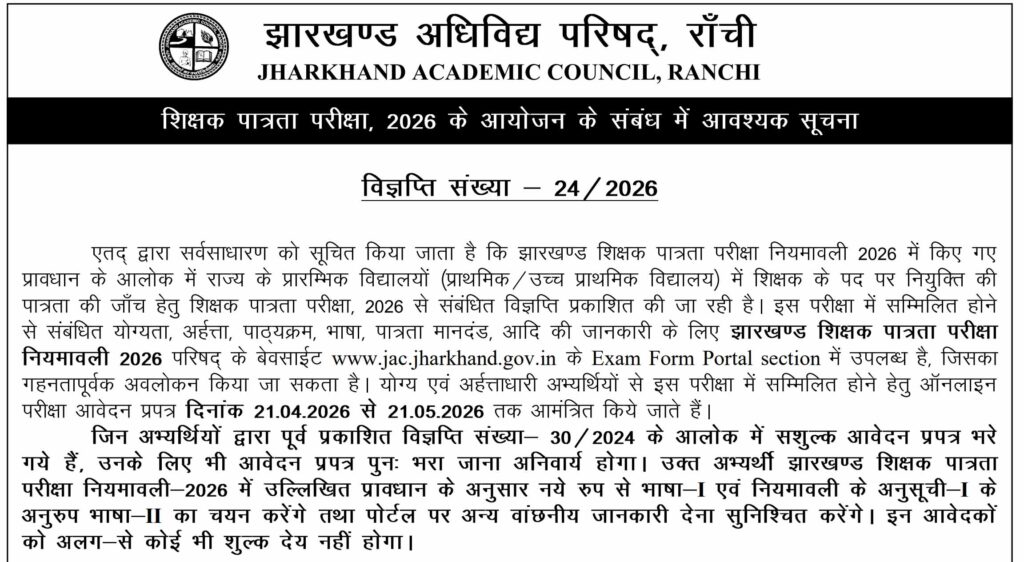
The detailed syllabus can be downloaded from the official JAC website at jac.jharkhand.gov.in.
18. Can I apply for both Paper 1 and Paper 2?
Yes, if you meet the eligibility criteria for both levels, you can apply for and appear in both exams.
19. What is the application fee for JTET 2026?
For a single paper, the fee is approximately ₹1300 for General/EWS/BC and ₹700 for SC/ST/PwD. Fees for appearing in both papers are slightly higher (approx. ₹1500 for General).
20. What is the best way to prepare for the Pedagogy section?
Focus on NCERT textbooks and previous year CTET/JTET papers. Understanding the Child Development & Pedagogy (CDP) theories by Piaget, Vygotsky, and Kohlberg is essential.
How to Crack JTET 2026: Strategy and Syllabus Guide
This video provides a deep dive into the 2026 preparation strategy, highlighting the specific changes in the exam pattern and which sections to prioritize for a high score.